
Insights

The Net Zero Investment Framework (NZIF) Portfolio Decarbonisation Reference Objective (PDRO) is its most used yet most often misunderstood component. We explore how a deeper understanding of portfolio emissions reductions can yield valuable insight.
Where within NZIF do net zero objectives fit
NZIF proposes that net zero goals be quantified as net zero objectives, most notably via its Portfolio Decarbonisation Reference Objective but also via an Allocations to Climate Solutions Objective. These objectives establish and quantify long-term net zero goals so they can be monitored overtime. Once net zero objectives have been established, a net zero strategy should be devised, and a transition plan implemented that uses available levers of influence.The importance of maximising contributions to real economy emission reductions
During implementation, NZIF recommends investors support real economy emissions reductions to the maximum practical extent possible, recognising that it is only through this reduction that the systemic financial risks posed by climate change can be mitigated.It further emphasises that reducing financed emissions attributed to a particular portfolio is not necessarily ‘Paris-aligned’. The Paris Agreement calls for financial flows towards low carbon and resilient development: not for attributed financial portfolio emissions to mirror integrated assessment models for global decarbonisation.
Why financed emissions don’t tell the whole story
The PDRO can use absolute or emissions intensity-based metrics, and has been used by investors to subsequently develop net zero targets. However, their characteristics make them unsuitable for net zero target setting. In summary, they are not forward-looking, do not consider the purpose of the finance, can be reduced ‘on paper’ by divestment, and can fluctuate due to changes in business activity, enterprise valuation, or currency value.How investors can understand their contribution to real economy emission reductions
An important benefit of establishing the PDRO within NZIF is that it supports performance monitoring. From here, investors can attribute drivers of change to build a more comprehensive understanding of why portfolio emissions have changed. This can provide critical information to support engagements, allocation decisions, and increase awareness of strategy effectiveness.The key drivers of portfolio emissions change
Undertaking this attribution analysis separates the drivers of real economy decarbonisation from decarbonisation on paper at the portfolio level. The drivers of portfolio emissions change are numerous, but can broadly be split into four categories:- Asset level emissions metrics (e.g. reductions or increases in the underlying assets’ emissions profile)
- Portfolio composition (e.g. divestment or sectoral allocation decisions)
- Financial metrics (e.g. EVIC changes)
- Data (e.g. methodology change)
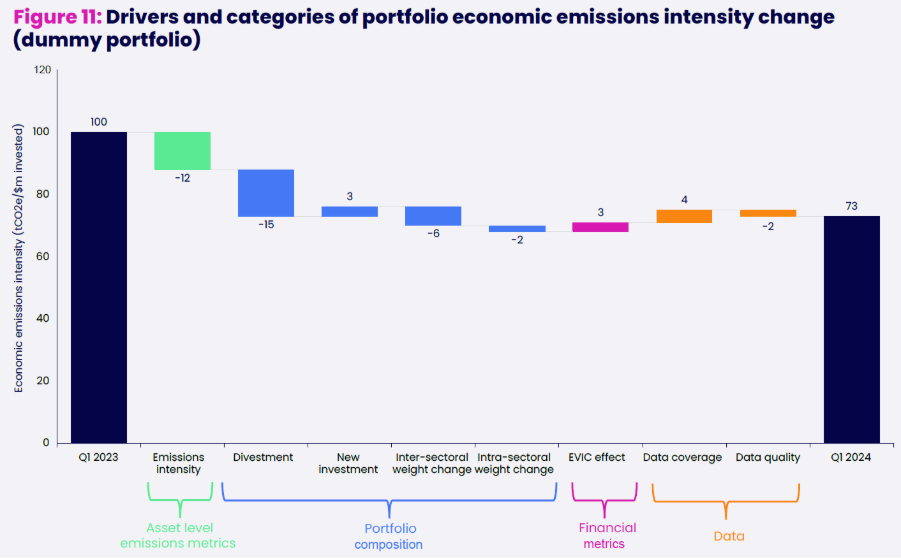 Source: Net Zero Investment Framework: Implementation Guidance for Objectives and Targets
Understanding the underlying causes of portfolio decarbonisation can yield significant opportunities.
Turning insight into action with attribution analysis
Insights gained here can guide engagements with underlying assets, clients, external fund managers, and even policymakers on the limitations of existing regulation. Internally, it can inform investment teams of progress against the organisation’s climate goals and efficacy.
Crucially, this practice can help investors distinguish the extent to which portfolio level emissions reductions stem from real economy decarbonisation, helping investors understand and improve their real-economy impact.
It’s how you get to portfolio decarbonisation that counts
Setting the Portfolio Decarbonisation Reference Objective is the starting point of an investor transition plan. Achieving it is the end point. But it’s how you get there that counts.
Our NZIF implementation guidance offers more detail on how to conduct attribution analysis.
IIGCC, in collaboration with investor members, has published case studies on the PDRO and attribution analysis. See here.
Disclaimer: This Insight is provided for general information only and does not constitute financial, legal, accounting, tax or investment advice or any recommendation. Investors are responsible for their own decisions and must act independently, taking account of their own circumstances, obligations and applicable legal and regulatory requirements.
Be the first to access our working groups, resources and guidance as an IIGCC member. Interested in finding out more? Get in touch today.