
Insights

Climate change, biodiversity loss, and even policy fragmentation represent systemic risks to investors’ portfolios. They cannot be diversified away from, nor addressed through company-level engagement alone. They demand action across markets, sectors, and policies. This Insight explores systems stewardship in response to these challenges.
Taking a wide-lens view of climate risks and the interconnected systems that can mitigate or hinder progress towards net zero and reversing nature loss is central to IIGCC’s work. This is why the Net Zero Investment Framework (NZIF) 2.0 places equal importance on asset-level assessment and targets, stakeholder and market engagement, and policy advocacy. The NZIF wheel is the essence of systems stewardship: harnessing levers across systems to affect real-economy decarbonisation. 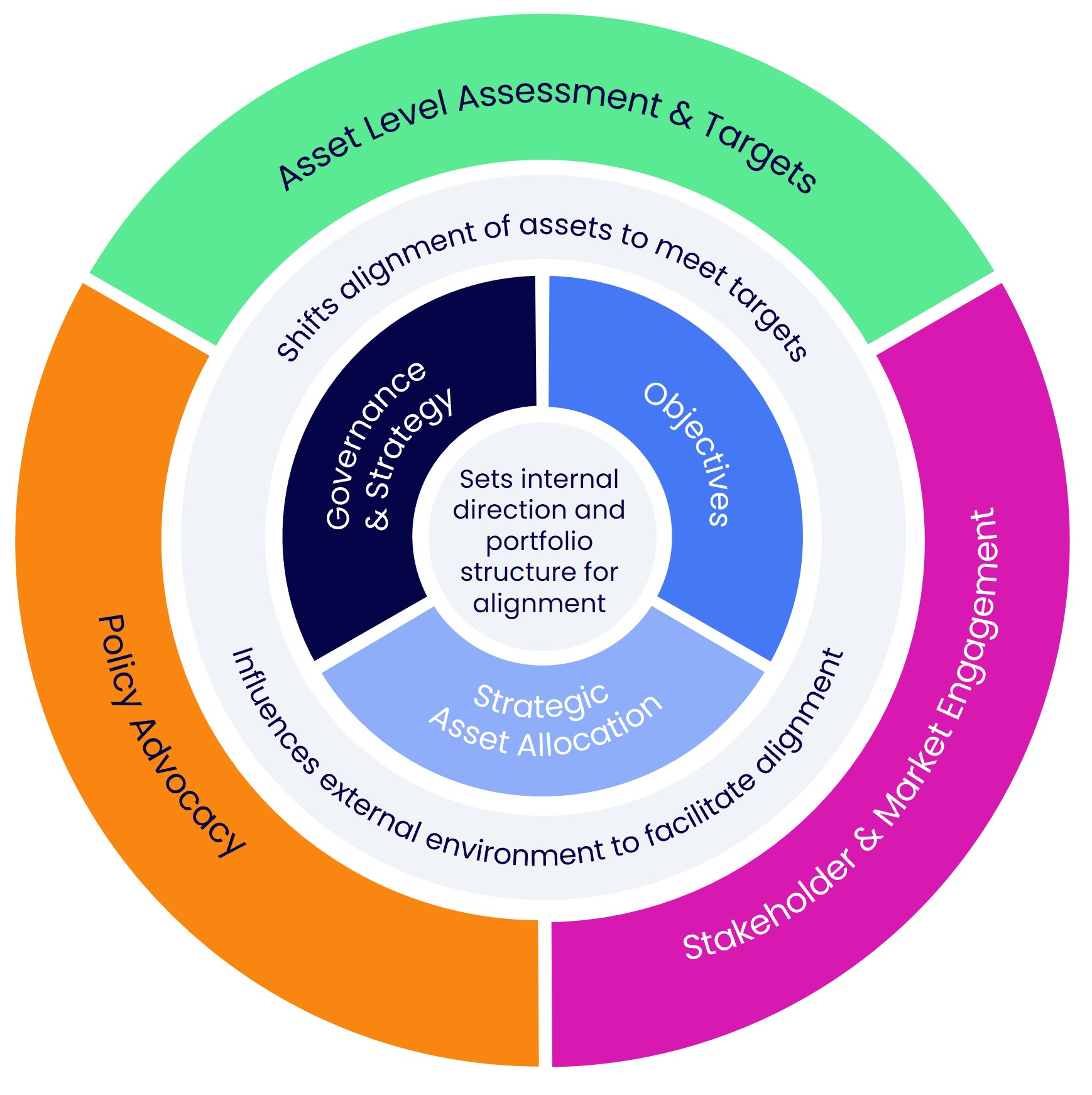
But systems stewardship risks becoming a buzzword if not applied to the real world. This Insight asks our Head of Stewardship Research, Laith Cahill, what systems stewardship is, how it extends beyond company-level engagement, and what it looks like in practice.
This conversation builds on IIGCC’s recent roundtable on Systems Stewardship and will continue at our upcoming panel at IIGCC Engage 2026, From Influence to Impact: The Role of Systems Stewardship in Net Zero, and in future climate stewardship guidance.
What is systems stewardship?
Systems stewardship can be simply understood as an evolution of traditional stewardship, brought on by the need to address systemic risks.
Systems stewardship recognises that no company is an island unto itself. Where ‘engagement’ once might have meant only dialogue with individual companies, now it extends out across sectors and value chains, to other market actors, and to regulators and policymakers. Its focus is often systemic risks, but it can also address idiosyncratic risk through the interaction of key stakeholders.
Why does systems stewardship matter for investors?
The turn towards systems stewardship is driven by the need to address systemic risks that can undermine the stability of entire markets and economies. I think it’s important to remember that many of the risks posed by climate change and biodiversity loss are non-diversifiable risks that can impact the entirety of the market.
The recent report by the UK Sustainable and Finance Association, in partnership with Scottish Widows, as well as Canbury, who joined our roundtable, makes this point well: with ~75% of long-term portfolio returns generated by market performance (commonly referred to as beta), this matters to investors’ ability to generate long-term returns.
Systems stewardship tackles these large-scale, interconnected challenges by leveraging insights and resources from policymakers, regulators, other investors, companies, and other stakeholders. It seeks to influence the behaviour of the systems, rules, norms, and policies that shape markets and respond to risks.
Can you provide an example?
The net zero transition of hard-to-abate sectors is a great example of where systems thinking is needed. Take the steel sector. It is responsible for around 8% of the EU’s CO2 emissions; a crucial input to other strategic industries; capital intensive; and hard to abate. Real-economy emissions reductions are contingent on a decarbonising steel sector. But steel companies cannot decarbonise alone. With high emissions throughout their value chain and technological challenges, steel companies are hard to abate because they are reliant on technological advances, policy signals and demand for green steel. A systems stewardship approach can bring these systems together, engaging across the value chain and with policymakers to unblock the very barriers to transition.
What are the challenges for systems stewardship?
In many respects, the challenges are no different from traditional stewardship. How are you effectively resourcing your stewardship and engagement teams, and how are you measuring outcomes?
Nonetheless, these challenges take on new guises for systems stewardship. On resourcing, how are you ensuring that colleagues have the skill set and experience needed to engage with policymakers? How are policy advocacy colleagues’ efforts folded into stewardship engagements? On impact, how can you attribute changes at the policy or regulatory level to your engagements?
Prioritisation is another challenge. As the lens widens, more and more actors come into view. How to identify where you as an investor can have the most impact is a challenge. One example from our roundtable focused on energy grid resilience for transport-linked portfolios and on aligning engagement with net zero strategies.
What are the enablers for systems stewardship?
Collaboration is a critical enabler for systems stewardship. In directing engagement across different actors, and responding to systemic risks affecting the entire market, there is an opportunity to bring investors together. Action through platforms like IIGCC, such as our lobbying thematic or policy advocacy, helps pool resources and amplify the investor voice.
How are investors already thinking about systems stewardship?
Investors are at different stages. For some, systems stewardship may never be a major component of their work, for others it is already a central plank in their stewardship activities. Either way, expectations are growing.
The Asset Owner Statement on Climate Stewardship was published in February 2025 by 26 asset owners across the UK, Europe, Australia and the US. The letter called for industry, market and public policy engagement (otherwise known as systems stewardship) to be core to the climate stewardship proposition of asset managers.
The UKSIF report demonstrates how this can be achieved through policy engagement, cross-industry collaboration, targeted shareholder resolutions, and challenging companies’ lobbying activities.
We were fortunate to be joined by Aviva Investors at our recent roundtable. Aviva Investors has long adopted a holistic approach to stewardship, engaging at both micro-(issuer) and macro-(system) levels to tackle systemic risks. As part of this, Aviva Investors hosts value-chain roundtables that bring together corporates, trade associations, NGOs and investors to identify policy obstacles and co-develop solutions.
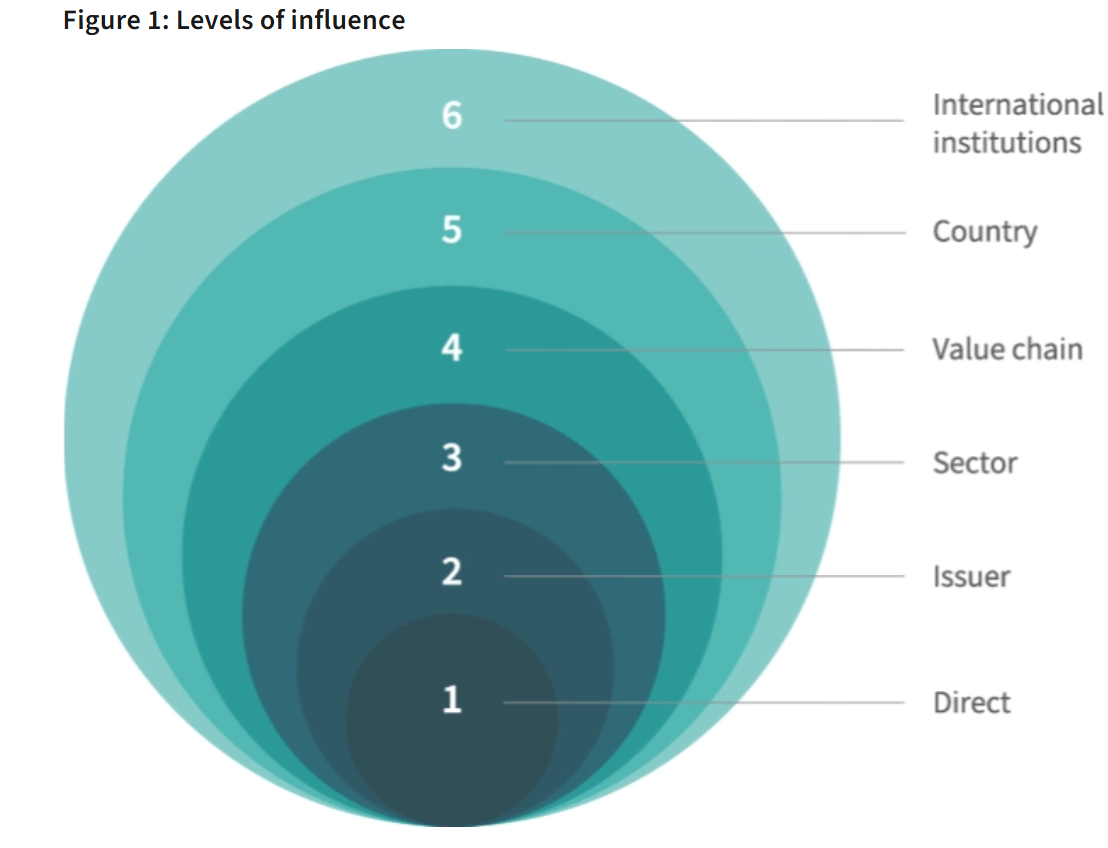
Source: Aviva Investors, September 2024.
What does effective policy engagement look like?
IIGCC is fortunate to have an effective and well-resourced policy team that has been engaging with investors on these issues for years. In our recent roundtable
Aviva Investors stressed three success factors for effective policy engagement: building access and relationships, framing policy asks as economic growth opportunities to unlock private capital or other tailored arguments, and maintaining persistence and consistency over multi-year horizons.
What is IIGCC’s approach to systems stewardship?
IIGCC continues to build out its work on systems stewardship, both at a theoretical level and through providing practical support to investors. A good example of the latter is our cross-programmatic engagement workstream, which brings together corporate lobbying engagement with direct policy advocacy. This dual-track approach aligns company-level asks with system-level objectives, creating efficiencies and strengthening investor influence across issuers, the value chain, regulators, and policymakers.
The workstream operates in three steps:
-
Identify priority climate and nature policies
-
Support investor engagement with companies on lobbying transparency and alignment with companies on their lobbying activities and related disclosures
-
Facilitate direct engagement with policymakers to advocate for the maintenance or introduction of enabling policies.
A recent example is the automotive sector engagement around EU policies to support road transport decarbonisation. Through this work, we connect issuer-level lobbying with EU policy advocacy, ensuring consistent messages across the ecosystem and amplifying investor impact in an important and challenging debate.
Systems stewardship complements traditional, company-led engagement by addressing market conditions that shape real-economy outcomes and long-term returns. As investors deepen their responses to systemic risks, focusing efforts where influence and materiality align will be key, along with collaboration through platforms such as IIGCC.
We look forward to working with members throughout 2026 to translate this agenda into practical outcomes – and invite you to continue the conversation at IIGCC Engage 2026 on Tuesday, 10 February.
Disclaimer: This Insight is provided for general information only and does not constitute financial, legal, accounting, tax or investment advice or any recommendation. Investors are responsible for their own decisions and must act independently, taking account of their own circumstances, obligations and applicable legal and regulatory requirements.
Be the first to access our working groups, resources and guidance as an IIGCC member. Interested in finding out more? Get in touch today.